A Rust NIF Without the Fear
The received wisdom about NIFs is that they can bring down the entire VM, which is true, and that you should therefore avoid them, which does not follow.
We needed SimHash over a few million documents. In pure Elixir it was about 40ms per document, which was not going to work. In Rust, via Rustler, it was under a millisecond. That is the kind of gap worth taking a risk for — provided you know which risks you are taking.
Rule one: never block a scheduler
A NIF that runs longer than about a millisecond starves the scheduler it runs on. The whole preemption model of the BEAM assumes it can take a process off a core; a native function ignores that assumption entirely.
Rustler makes the fix a single annotation:
#[rustler::nif(schedule = "DirtyCpu")]
fn simhash(text: &str) -> u64 {
    hash_tokens(tokenize(text))
}
Dirty schedulers exist precisely for work that cannot be preempted. Use them for anything you have not personally measured under a millisecond, and measure before you decide you are the exception.
Rule two: do not panic
A Rust panic across the NIF boundary takes the VM with it. Every fallible path must return an error term instead:
#[rustler::nif(schedule = "DirtyCpu")]
fn parse(input: &str) -> Result<Document, Error> {
    serde_json::from_str(input).map_err(|e| Error::Term(Box::new(e.to_string())))
}
Then the Elixir side gets an ordinary tagged tuple, and an ordinary supervisor handles it:
case Native.parse(payload) do
  {:ok, document} -> {:ok, document}
  {:error, reason} -> Logger.warning("unparseable payload: #{reason}"); :skip
end
Deny panics at the crate level and the compiler helps you keep the rule:
[lints.clippy]
unwrap_used = "deny"
expect_used = "deny"
Rule three: keep the boundary boring
The NIF should do one computational thing and hold no state. No global mutable structures, no threads you spawn yourself, no callbacks back into Elixir. Everything that needs supervision, retries, or lifecycle belongs on the BEAM side where those things already work.
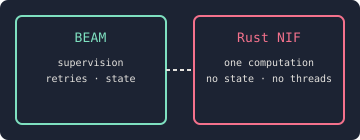
Where the fear lives
Every NIF horror story is a violation of one of the three rules. Check the story against the rules before checking your code against the story.
Three rules, and the fear mostly goes away. What is left is a normal engineering tradeoff: a build dependency and a compile step, in exchange for two orders of magnitude.